And Light / Touched / Turns Dark: Lucia Pietroiusti for Aleksandra Kasuba
Published by Tate on the occasion of Aleksandra Kasuba: Shelters for the Senses, Tate St Ives, 2026
Buy the book →
View the exhibition →
Full text below
And Light
Touched
Turns
Dark
For 65 years, the Lithuanian artist, architect and writer Aleksandra Kasuba collected her dreams. Over time, she worked them into a series of poems, resulting in the collection, In the Wake of Dreams. Here, images and stories, freed from chronology, are arranged according to fundamental movements and tropes which, the artist suggests, belong less to an individual dreamer and more to “collective memory… echoing those recorded in myths of all nations.”
In In the Wake of Dreams, we find much of Kasuba’s environmental philosophy, phenomenology, and even her engineering principles appearing in raw form, embedded in the poems’ architecture. Lines, images and movements appear in tensile suspension. The senses are saturated with cosmic stimuli; fields of perception, materiality and meaning float in infinite, non-gravitational space:
New to the ways of light
new to the ways of the void
I sat down feet dangling over the breathing abyss.
Remembering lightbeads under my arms
splitting them into rays
and rays into strands fit for braiding
I started knotting a safety net–
starbeams moonbeams and sunbeams
replenishing themselves
without breaking.
To meander through Aleksandra Kasuba’s oeuvre, from her earliest, flowing stone mosaics, through her fabric environments, is to surrender to a cosmic vision that far exceeds the possibilities afforded by modernist form. It is to become re-acquainted with what is most elemental on Earth: sinuous shapes, embodiment, the near-absence of parallel and orthogonal lines. Hers is a vision shaped by an attunement to planetary energies and the profound, enfleshed acceptance that the individual belongs and is shaped by a much larger whole.
We experience this in Shell Dwellers, a series of collages Kasuba produced in 1989, in which her biomorphic, shell-like living architectures are embedded into patchworks of environmental colours and pattern, each reminiscent of landscapes that the collages sensually exaggerate: desert rock; icy worlds; dense forest landscapes. In each, the shell-dwelling remains unchanged yet blends seamlessly into its background. Shell Dwellers proposes a vision of architecture which, far from abstracting itself from its surrounding natural environment, draws inspiration from it, nestles into it, and finds harmony within. The eponymous ‘shell dwellers’ are imagined communities of humans that have resolved their contradictory relationships with the vastness of the more-than-human world and, in folding back into it, achieve a new level of consciousness. Her biomorphic drive eventually led her to the New Mexico high desert in 2001, where she constructed the Rock Hill House, a complex of shell dwellings made from timber, mesh, and spray foam. These structures, resembling seed-pods or seashells, synthesised her proposal for architecture as an instrument of embodied, lived-in philosophy-in-practice.
As Kasuba herself writes in The Seven Faces of Time:
There is a time when the past and future part ways and the present stops fleeting. It happens when I become other than myself - say, a pigeon strutting, straining to rise, or maybe a drop of water, swelling as the drop swells, rolling over as it does, and while hanging upside down, learning what every drop of water already knows… By becoming “other”, I take measure of myself. In the absolute now, the world is a mirror held up to me, and I am a mirror to all.
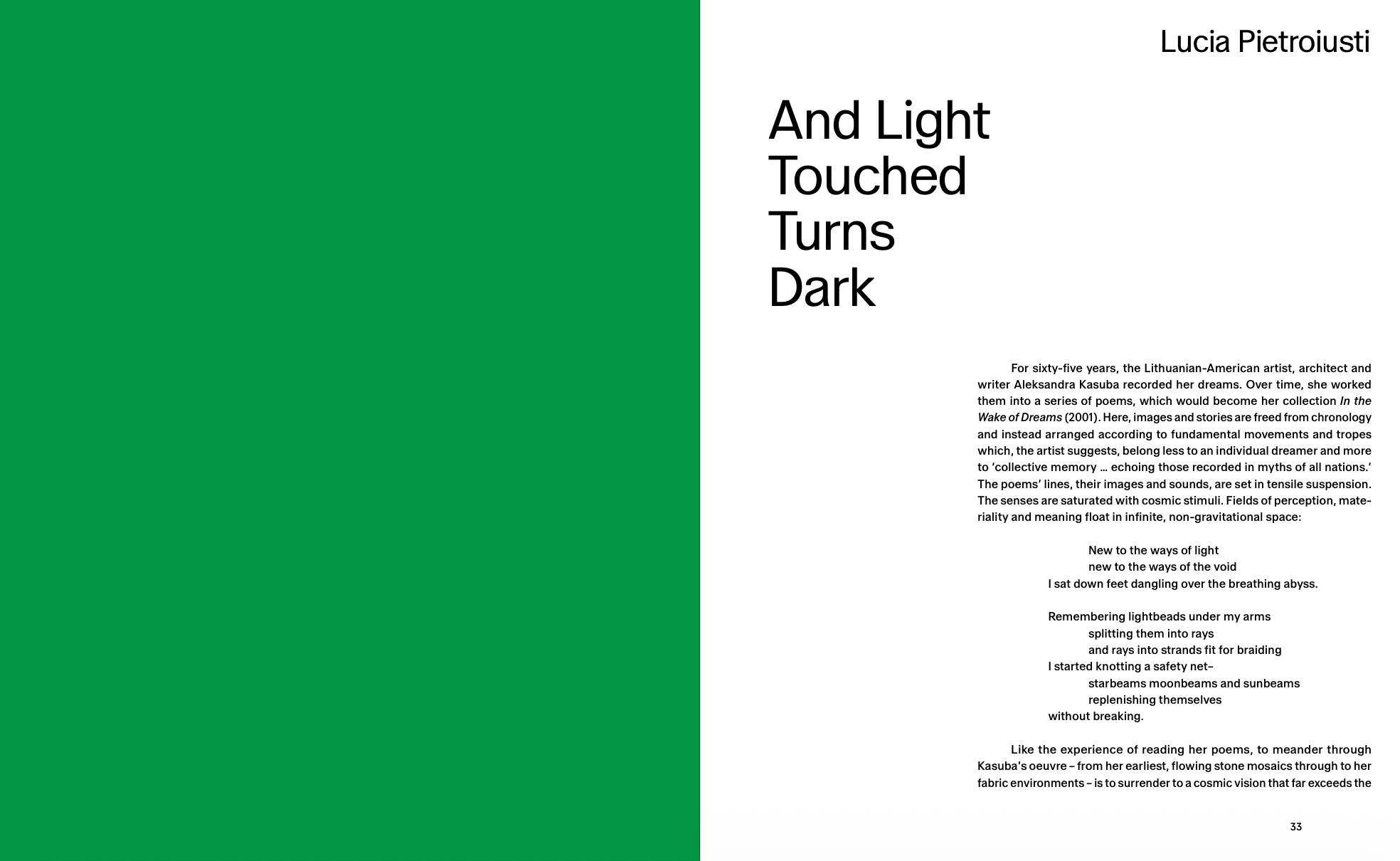
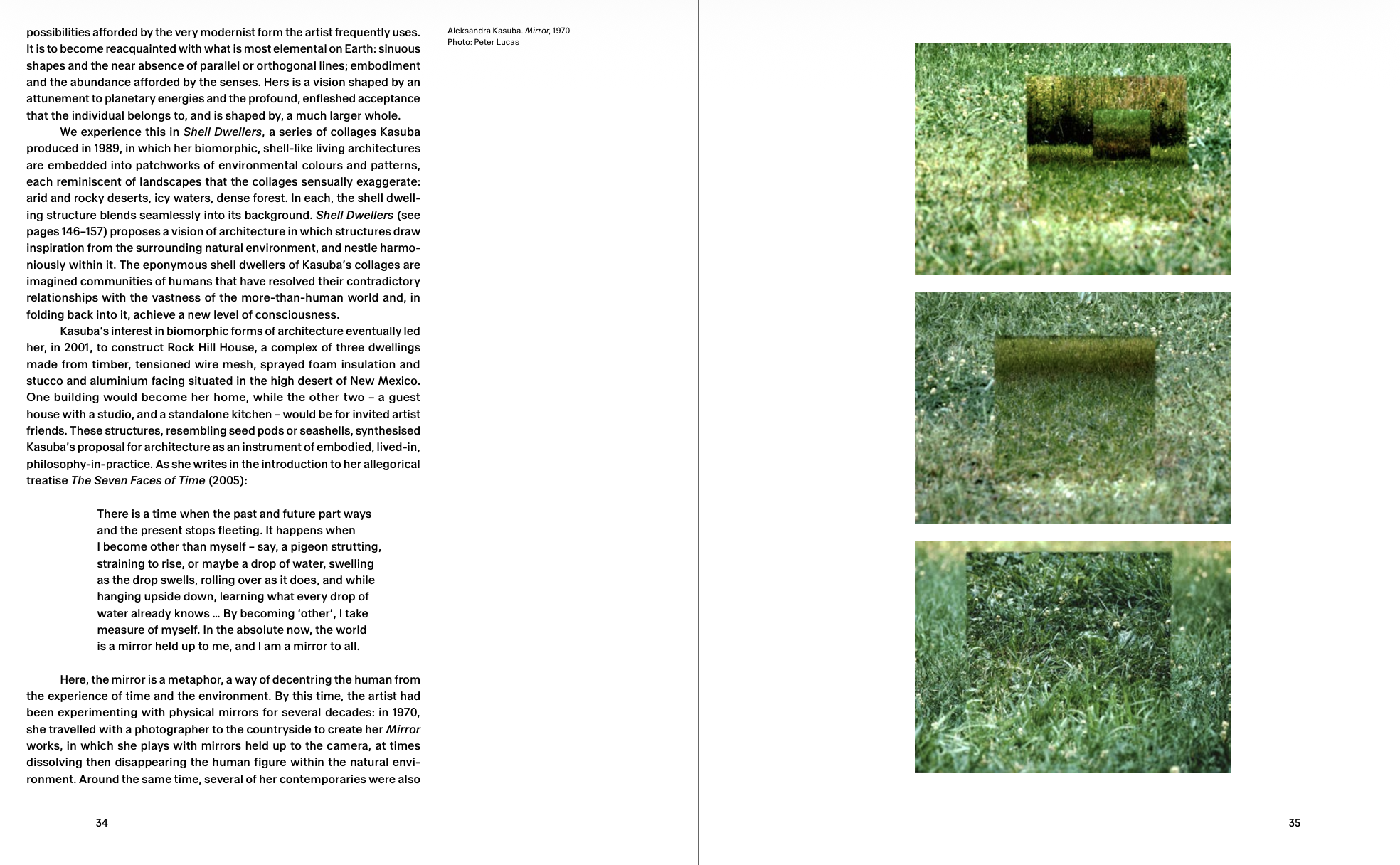
“Mirrors and poetry, as well as myth and fairytales, refract reality in unexpected ways,” writes performance artist Joan Jonas, whose 1969, iconic work, Mirror Piece sets performers in a natural landscape holding full-length mirrors. 1969 also marked Robert Smithson’s first Mirror Displacements work in the Yucatán peninsula. Where Jonas deploys the mirror as a performative device in relation to the body, and Smithson as a tool of landscape intervention, Kasuba uses it to erode the boundary between figure and environment. Her 1970, Mirror works experimented with dissolving, then disappearing, the figure of the human within nature, literalising the artist’s conviction that perception is relational rather than fixed.
Kasuba’s cybernetic-inflected, proto-mystical understanding of the relationship between individual and environment is encapsulated in some of her theoretical work. The world, to her, is not as a collection of static objects but as an open system consisting of many energy events; and agency is distributed between an external system (the environment) and the individual, through the medium of a dynamic exchange. In the treatise, The Mind Gazing at Itself, the interactions between the environment and an individual’s reasoning, emotional and intellectual centres are determined by flows of energy which follow the path of least resistance, ultimately seeking balance. In this formulation we understand Kasuba’s environmental consciousness as a product of the historical context within which it was nurtured, and the influence of cybernetic thinking on the understanding of feedback, energy and agency. We may be reminded here of ways in which this cybernetic vision influences visual art to this day, such as the work of French artist Pierre Huyghe, many of whose projects make of the exhibition’s atmospheric conditions a medium of the work itself, experimenting with entangling ecosystemic or algorithmic processes with the unfolding and transformation of the artworks.
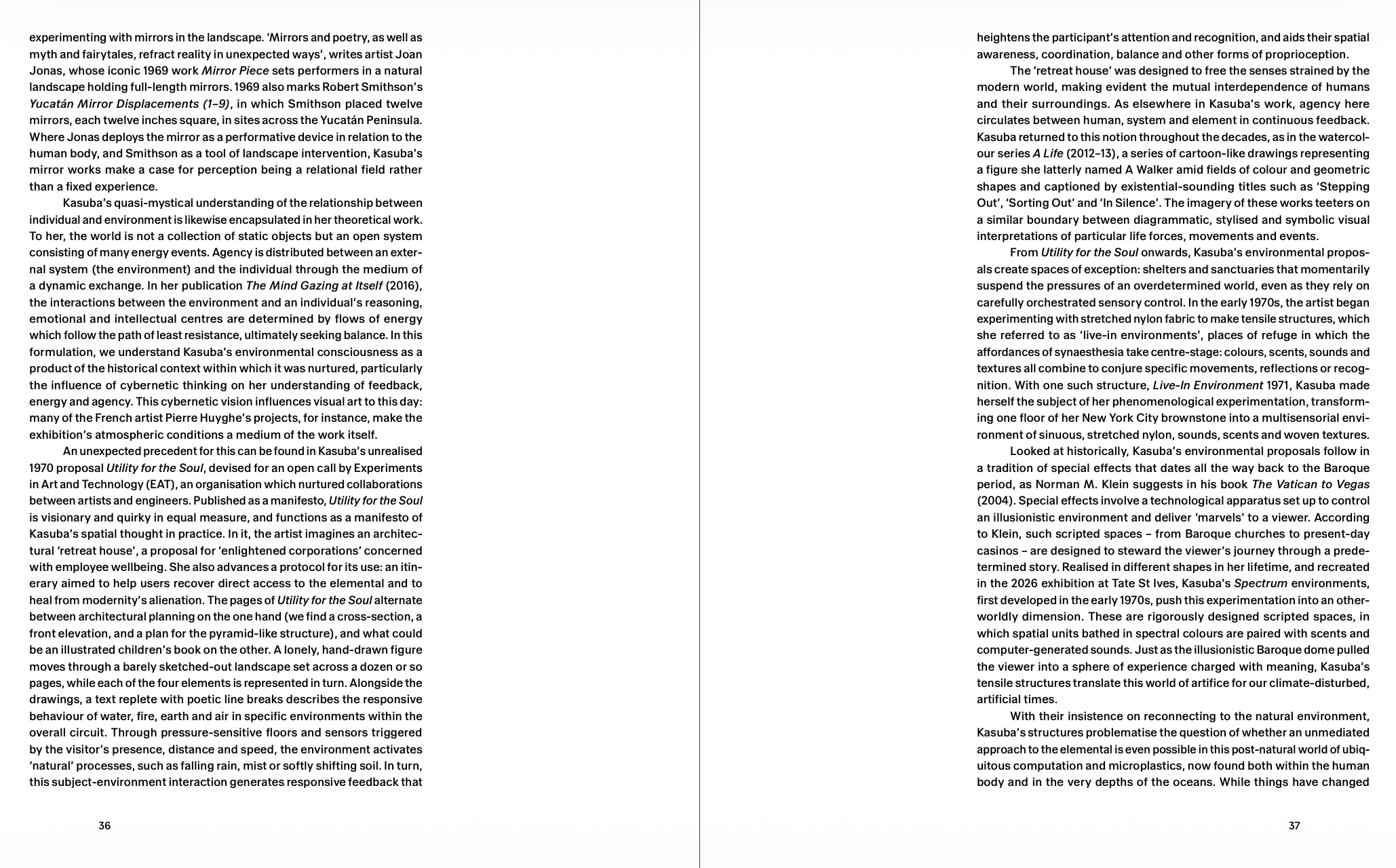
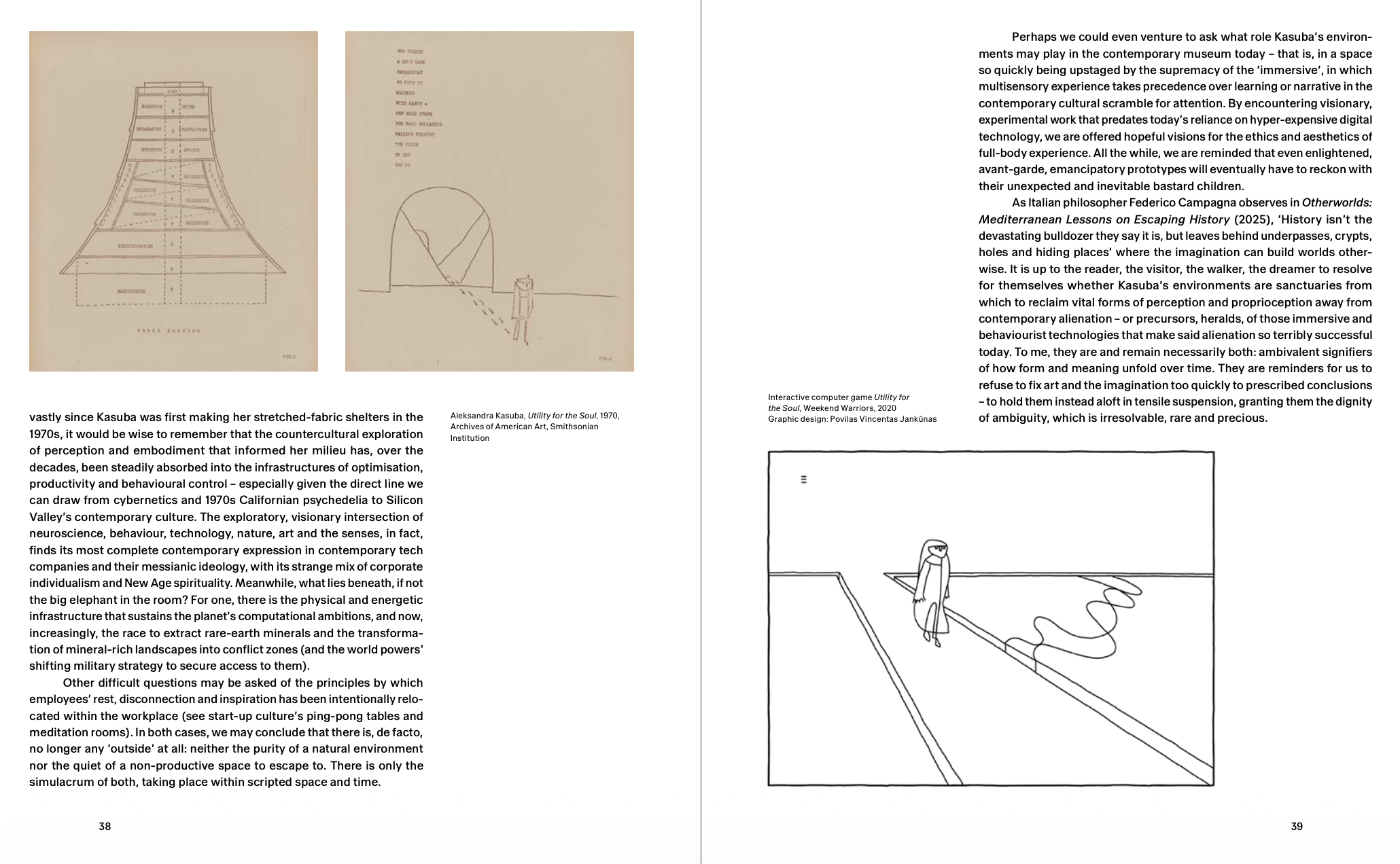
An unexpected precedent can be found in Kasuba’s 1970 unrealised proposal, Utility for the Soul, devised in response to an open call and competition by Experiments in Art and Technology (E.A.T.) for a programme titled Projects Outside Art. Utility for the Soul is singularly visionary, quirky and strange, and functions as a manifesto of Kasuba’s thought in practice. In it, the artist imagines an architectural ‘Retreat House’, commissioned by a hypothetical enlightened ‘Corporation’ concerned with employee well-being. She also proposes a protocol for use: an itinerary aimed to help users recover a direct access to the elemental and healing from modernity’s alienation. The work’s pages alternate between architectural planning (we have a cross-section, a front elevation, and a plan of a pyramid-like structure) on the one hand, and what could be an illustrated children’s book, on the other. A lonely, hand-drawn figure moves through a minimal landscape in which one of the four elements is represented in turn. Alongside the drawings, a text, replete with poetic line breaks, describes the responsive behaviour of water, fire, earth and air within specific environments within the overall circuit. Through pressure-sensitive floors and sensors, the environment would activate "natural" behaviours, from falling rain, to forming mist or sinking soil, triggered by the visitor’s distance, presence and speed of movement. This subject-environment interaction would create a responsive feedback that would heighten attention, recognition and aid proprioception. It was designed to free the senses strained by the modern world, making evident the mutual interdependence of humans and their surroundings. As elsewhere in Kasuba’s work, agency here circulates between human, system and element in continuous feedback. Kasuba returned to this throughout the decades, such as in the watercolour series A Life, from 2012-13, which teeter on a similar edge between diagrammatic, stylised and symbolic visual interpretations of particular life forces, movements or events.
From Utility for the Soul onwards, Kasuba’s environmental proposals create spaces of exception: shelters and sanctuaries that momentarily suspend the pressures of an over-determined world, even as they rely on carefully orchestrated sensory control. Her spatial, live-in environments, created from stretched nylon fabric, are spaces of refuge in which the affordances of synaesthesia take centre-stage: colours, scents, sounds and textures all combining to conjure specific movements, reflections or recognition. With Live-In Environment, from 1971, Kasuba made herself the subject of her own phenomenological experimentation, having transformed a floor of her New York City brownstone into a multi-sensorial environment of sinuous, stretched nylon, sounds, scents and woven textures.
Looking at it historically, Kasuba’s environmental proposals follow in a tradition of "special effects" that can date all the way back to the Baroque period, as Norman M. Klein proposes in The Vatican to Vegas. Special effects involve a technological apparatus set up to control an illusionistic environment, to deliver "marvels" to a viewer. According to Klein, such “scripted spaces”, from Baroque churches to present-day casinos, are designed to emphasise the viewer’s journey through a story. Realised in different shapes in her lifetime, and re-created in the exhibition at Tate, Kasuba’s Spectrum environments push this experimentation further and extend it into the possibilities of utterly alien, enclosed environments whose chromatic uniqueness pushes the experience into an otherworldly dimension. These are rigorously designed scripted spaces, where spatial units bathed in spectral colours were paired with scents and computer-generated sounds. Just as the illusionistic Baroque dome pulled the viewer into a sphere of experience charged with meaning, Kasuba’s tensile structures translate this world of illusion for our climate-disturbed, artificial times.
With their insistence on reconnecting to the natural environment, Kasuba’s environments problematise the question: is an unmediated approach to the elemental even possible in this postnatural world of computation, microplastics and rare earth minerals? While the world of today looks vastly different from the 1970s reality outside Kasuba’s stretched-fabric shelters, it would be wise to remember that the countercultural exploration of perception and embodiment that informed Kasuba’s milieu has, over the decades, been steadily absorbed into the infrastructures of optimisation, productivity and behavioural control. The exploratory, visionary intersection of neuroscience, behaviour, technology, nature, art and the senses finds its most complete contemporary expression in Silicon Valley’s spiritual and prophetic ideology. Meanwhile, underneath it lies a behemoth: the physical and energetic infrastructure that sustains the planet’s computational ambitions. Similar questions may be asked of the principles by which employees’ rest, disconnection and inspiration has been intentionally transported within the enclosure of the workplace (see start-up culture’s ping-pong tables and meditation rooms). In both cases, we may question whether there is, de-facto, no longer any “outside” at all. Neither the purity of a natural environment nor the quiet of a non-productive space to escape to: only the simulacrum of both taking place within scripted space and time.
Perhaps we may even venture to ask what role Kasuba’s multi-sensory environments may be able play in the contemporary museum space today, a space that is being quickly upstaged by the supremacy of the “immersive”, in which multi-sensory experience takes precedence over learning or narrative in the contemporary cultural scramble for attention. By encountering visionary, experimental work that predates today’s reliance on hyper-expensive digital technology, we are offered hopeful visions for the ethics and aesthetics of full-body experiences. All the while, we are reminded that even enlightened, avant-garde, emancipatory prototypes will eventually have to reckon with their unexpected and inevitable bastard children.
As Italian philosopher Federico Campagna observes in Otherworlds: Mediterranean lessons on Escaping History, "History isn’t the devastating bulldozer they say it is," but leaves behind "underpasses, crypts, holes and hiding places" where the imagination can build worlds otherwise. It is up to the reader, the visitor, the walker, the dreamer to resolve for themselves whether Kasuba’s environments are sanctuaries, independent spaces to reclaim vital forms of perception and proprioception away from contemporary alienation – or indeed precursors or heralds of those immersive and behaviourist techniques that makes said alienation so incredibly successful. For me, they are and remain necessarily both, ambivalent signifiers of how form and meaning unfold over time. They are reminders for us to refuse to fix art and the imagination too quickly to prescribed conclusions – to hold them, aloft, in tensile suspension, granting them the dignity of ambiguity, which is irresolvable, rare and precious.